
Money Tree
Core tips: Money tree Scientific name: Zamioculcas zamiifolia Alias: Zemi taro, Gold coin tree, Citro taro, Zemi leaf Araceae Genus: Araceae Citroecia Morphological characteristics: Perennial evergreen herbaceous plant, money tree plant height 30~50 cm, underground with fat tubers, light yellow. Pinnate compound leaves from the top of the tuber

Money tree Scientific name: Zamioculcaszamiifolia Aliases: Zemi taro, Golden coin tree, Citro taro, Zemi leaf Araceae Family: Araceae Genus: Citroca genus.
Morphological characteristics of money tree: money tree is a perennial evergreen herbaceous plant, money tree plant height 30~50 cm, with fat tubers underground, light yellow. Pinnate compound leaves emerge from the top of the tuber, leaflets are opposite or nearly opposite on the leaf axis, leaflets ovate, entire, thick leathery, apex sharp, shiny. The flowers are thin and small, light green.
Ecological habits of the money tree: The money tree is native to the tropical (grassland) climate zone with low rainfall in eastern Africa, and likes warm and slightly dry, semi-shaded and small annual average temperature changes, and is more drought-tolerant, but afraid of cold, avoid strong light exposure, afraid of soil stickiness and water accumulation in the pot soil, if the pot soil is not permeable, it is easy to cause its tubers to rot. The money tree requires loose, fertile, well-drained soil, rich in organic matter, and acidic to slightly acidic. The money tree has strong germination, and after cutting off the thick compound leaves, the top of its tuber should quickly sprout new leaves.
Money treeGardenUses: The money tree can be used as a potted ornamental.

Money tree
Money tree Latin scientific name: ZamioculcaszamiifoliaEngl. Other names: money tree, dragon and phoenix wood, Zemi taro, American iron taro Family: Araceae Genus: Money tree genus.
The money tree is a perennial evergreen herbaceous plant that is extremely rare foliage with underground tubers. The aboveground part has no main stem, adventitious buds germinate from the tuber to form large compound leaves, the leaflets are fleshy with short petioles, firm and dark green; The underground part is hypertrophied tubers. Pinnate compound leaves are extracted from the top of the tuber, the leaf axis is strong, and the leaflets are opposite or nearly opposite on the leaf axis. Buddha flame flower buds are green, boat-shaped, and the flesh spikes are short.
The money tree is native to the savannah climate zone of eastern Africa with low rainfall and was introduced to China in 1997. The money tree is an indoor foliage plant that purifies indoor air. Its newly drawn pinnate compound leaves are almost always 2 pieces, one long and one short, one thick and one thin, so it is also known as "dragon and phoenix wood", and symbolizes the meaning: attracting wealth and treasure, glory and wealth.
1. Morphological characteristics of money trees
The aboveground part of the money tree has no main stem, the plant height is 50 to 80 cm, and there are fat tuberous stems underground, 5 to 8 cm in diameter. Adventitious buds germinate from tubers to form large compound leaves, leaflets fleshy with short petioles, and the hard part is a hypertrophied tuber; petiole base swollen, lignified; Pinnate compound leaves are extracted from the top of the tuber, each leaf axis has 6 to 10 pairs of opposite or approximately opposite leaflets, the leaves are ovate, thick leathery, green, with a metallic luster. Buddha flame flower buds are green, boat-shaped, and the flesh spikes are short.
2. The growth habit of money trees
The money tree likes warm and slightly dry, semi-shaded and slightly shaded and has little annual average temperature change, and is suitable for growing at 20 °C to 32 °C. It is more drought-tolerant, but it is afraid of cold, avoid strong light exposure, fear of soil stickiness and water accumulation in the pot soil, and if the pot soil is not permeable, it is easy to cause its tubers to rot. The soil is required to be loose and fertile, well-drained, rich in organic matter, and acidic to slightly acidic. It has strong germination power, and after cutting off the thick pinnate compound leaves, new leaves will quickly emerge at the tips of its tubers.
3. The propagation method of the money tree
1. Propagation by cuttings: Money tree cuttings can be used with a single small leaf, a leaf axis plus 2 leaves or a separate leaf axis. Cuttings with leaf axis blades take root quickly, have a high germination rate, and are relatively easy to open into larger tubers. Single leaf cuttings are taken on a mixed substrate mixed with river sand and vermiculite, and after 10-14 days, small spherical stems with roots can be formed at the base of the leaves, and after 2-3 months of cultivation, they can grow into small plants, but the seedling rate is generally not high. If the leaf axis or leaf axis with leaves as cuttings for cuttings, the substrate can be used general fine sand, or peat soil, perlite and river sand can be mixed in a ratio of 3:1:1 to prepare the substrate, the depth of the cuttings into the soil is 1/3-1/2 of the ear length, only leave the leaves outside the substrate, spray water and put it in the shade, maintain an ambient temperature of 25 °C-27 °C, depending on the dryness and wetness of the substrate, spray the foliar surface 1-2 times a day, maintain the substrate in a slightly moist state, do not be too wet, otherwise cause cutting rot, Resulting in the failure of cuttings.
2. Propagation by division: Depot the large money tree plants, shake off most of the old soil, break it from the weak part of the tuber bond, and apply sulfur powder or plant ash on the wound, and plant it in a pot. Be careful not to bury it too deep when planting, and bury the top of its tuber 1.5-2 cm under the soil. In addition, according to the characteristics of latent buds on the tubers of the money tree, a huge single tuber can be cut into small pieces with 2-3 latent buds, and after the wound is drier, it can be buried in slightly moist fine sand, and then potted after the cut tubers grow into independent plants.
3. Leaf cutting propagation: The money tree has huge tubers, which germinate many buds and small tubers that form many groups, and the compound leaves have a lifespan of more than 2-3 years, and are constantly renewed by new leaves. Usually money trees are propagated by separating small plants with small balls produced on the mother tubers, and large plants can only produce 2-5 plants per year, with a low reproduction coefficient and slow speed. Money leaf inserts are easy to root in the substrate and can be used for propagation. There are 15-25 leaflets on each mature compound leaf, which can greatly increase the reproduction rate if used for propagation. Cut small leaves or double-leaved with total petioles or single leaves with total petioles of different maturity levels and insert them into clean river sand beds, or directly cut them into peat and other substrates. When cuttings, the leaves should be laid flat or upright, and the sand bed should be kept moist after cuttings. After 50-60 days, the base of the petiole or total petiole appears swollen, followed by the lateral growth of thick new roots.
4. Cultivation technology of money trees
1. Temperature: The suitable temperature for growth is 20-32 °C, whether it is potted or ground planting, the average annual temperature change is required, and productive cultivation is best carried out in a temperature-controlled greenhouse. Every summer, when the temperature reaches more than 35 °C, the growth of the plant is not good, and measures such as covering the black net to shade the light and spraying water on the surrounding environment should be used to cool down, so as to create a suitable environment with a suitable space temperature and relatively dry space. It is best to maintain a shed temperature above 10 °C in winter, if the room temperature is lower than 5 °C, it is easy to cause cold damage to the plant and seriously endanger its survival. In late autumn and early winter, when the temperature drops below 8 °C, it should be moved to a well-lit room in time, and the temperature should be kept between 8 °C and 10 °C throughout the wintering period, which is safer and more reliable.
2. Lighting: The money tree likes light and has strong shade tolerance, so it should create an environment with good sunlight but a certain degree of shade. It should avoid direct light in strong light, especially avoid the scorching sun after the long rain and early summer and the unobstructed bright light baking for 5-6 hours before noon in summer, otherwise it is easy to cause burns to the newly drawn young leaves. During productive cultivation, from late spring to mid-autumn, it should be placed under a shade shed with 50-70% shading, but it should not be too dark, otherwise it will lead to slender newly sprouted leaves, yellow leaves and loss of focus, and sparse leaf spacing, thus affecting the compactness and beauty of the plant. Potted plants transplanted into the shed in winter should be given supplementary light. The pot soil remains dry, and the plant can remain disease-free for many years. The newly extracted pinnate compound leaves did not show obvious phototaxis, and the plant shape was good.
3. Moisture: In order to maintain the potted money tree, efforts should be made to create a moist and dry environment for it. During productive cultivation, for plants placed in greenhouses, when the room temperature reaches above 33 °C, the plants should be sprayed with water once a day. Because the plant has strong drought tolerance, it is better to keep the pot soil slightly moist and dry, but occasionally watering too much water and fertilizer will not cause root rot. In winter, pay attention to spraying water on the leaves and the surrounding environment to make the relative air humidity reach more than 50%. After the Mid-Autumn Festival, watering should be reduced, or sprayed instead of watering to help the newly sprouted leaves survive the winter safely. In addition, special attention should be paid to the potting soil should not be too wet in winter, and it is better to be dry, otherwise under low temperature conditions, the potting soil is too wet and more likely to lead to plant root rot and even the death of the whole plant.
4. Soil: Due to the special climatic conditions of the origin of the money tree, it has formed strong drought resistance, so the basic requirement for the cultivation substrate is good permeability. The basic requirement for cultivation substrate is good permeability. The cultivation substrate is mostly mixed with peat, coarse sand or rinsed cinder mixed with a small amount of garden soil, and its PH value is adjusted to between 6-6.5, which is slightly acidic. Because of its large tubers, developed root system, and long pinnate compound leaves, its growth should be observed in time during the growing season to decide whether to repot and change the soil. Always keep the cultivation substrate good in permeability to create a good root environment for air permeability and water filtration. During the rainy season, it is necessary to check frequently, and when water accumulation occurs in the pot, it is necessary to repot and change the soil in time.
5. Fertilization: Money tree is more fertilizing, in addition to adding an appropriate amount of soaked cake fertilizer or multiple slow-release compound fertilizer to the cultivation substrate, 02.% urea plus 0.1% potassium dihydrogen phosphate mixture can be poured 2-3 times a month during the growing season, and balanced fertilizer 20-10-20 (20-20-20) can be poured with a concentration of 200-250ppm combined with calcium nitrate for use. After the Mid-Autumn Festival, in order to make it survive the winter safely, nitrogen fertilizer should be stopped, and 0.3% potassium dihydrogen phosphate solution should be applied 2-3 times in a row to promote the hardening and enrichment of its young leaf shaft and newly extracted leaves. When the temperature drops below 15 °C, all forms of top dressing should be stopped to avoid causing fertilizer damage and root damage under low temperature conditions.
6. Note: At noon or in late spring and early summer, when it is rainy and sunny, you should pay attention to sun protection and give the plant appropriate shade. The potting soil should not be too wet in winter, otherwise it will cause the root system of the plant to rot under low temperature conditions, and it should be dry. When the temperature is below 15 degrees, all forms of fertilization should be stopped, otherwise fertilizers will harm the rhizomes under low temperature conditions. When it is particularly cold in winter, you need to pay attention to the cold protection of the plant, and you can put a double-layer plastic bag on the plant at night, and then take off the plastic bag when the temperature rises. In summer, you should listen to the weather forecast in time and prepare to shade the plants as soon as possible.
5. Prevention and control of money tree-related diseases
1. Brown spot disease
Symptoms of brown spot: Brown spot mostly occurs on leaves, and the lesions are nearly round, gray-brown to yellowish-brown, and the edges are slightly darker. The disease is prone to occur under conditions of high temperature, high humidity and poor ventilation.
Brown spot prevention and control: If a small number of diseased leaves are found, they should be removed and destroyed in time, and in the early stage of the disease, use 50% carbendazim wettable powder 600 times liquid or 40% chlorothalonil suspension 500 times liquid, spray the leaves every 10 days, 3 to 4 times in a row, and the control effect is better.
3. White silk disease
Symptoms of white silk disease: White silk disease, also known as sclerotiatic root rot and sclerotian seedling blight, is harmfulSeedlingsand the rhizome of young trees.
Symptom recognition of white silk disease: the affected area is first water-stained yellow-brown to reddish-brown wet rot; The central area of the lesion is slightly concave, the edges are obvious, and the surface of the diseased area is covered with white silk-like hyphae, which are radial and spread to the soil surface. The sclerotia are produced on the hyphae, which are white at first, and then turn yellow, reddish-brown to dark brown, and in severe cases, the whole plant is damaged, causing the aboveground stems and leaves to wilt and die.
The occurrence of white silk disease: most of the bacteria are distributed in the topsoil layer of 1 cm to 2 cm. When the temperature reaches 28°C to 35°C and the relative humidity reaches more than 90%, the sclerotia germinate, producing hyphae that spread in the soil.
Transmission route of white silk disease: invades from the epidermis or wound at the base of the root or petiole of the money tree, and begins to develop after 7 to 8 days of incubation, and the diseased part produces hyphae for re-infection or multiple infections.
Prevention and control of white silk disease: Remove diseased plants in time. The occurrence of diseases is closely related to water, pay attention to shelter from rain, drain waterlogging in time after rain and strengthen ventilation, and strictly prevent excessive humidity in the cultivation site.
To increase the soil pH, add appropriate scorched ash, plant ash or slaked lime to the potting soil, adjust it to 6.5 to 7.0, and add trace elements such as silicon and calcium.
The cultivation soil advocates high-temperature disinfection, baking and sterilization; Fifth, spray or water the surface of the substrate in the early stage of the disease with root flower friends, painted green, chlorothalonil and other agents for control. 、
4. Scale insects
Scale insect symptoms: Scale insect harm, in a poorly ventilated and poor light environment, the leaves of the money tree are susceptible to the stinging and sucking of scale insects.
Scale insect control: A small amount of family cultivation can be used to glue the insect body with scotch tape, or it can be wiped off with a damp cloth. Productive cultivation can be sprayed with 20% of paramethrin wettable powder 1000 times liquid during the peak incubation period of its nymphs, and the insecticidal effect is good.
5. Rotten roots
Root rot symptoms: Generally, the cause of root rot in money pine is root rot caused by watering.
Root rot control: It is necessary to pour the plant out of the pot in time, shake off part of the soil, put it in a semi-shaded cool place to dry for 1-2 days and then replace it with new sandy loam soil for planting.
Watering should not be too frequent, when the potting soil is 70% dry, there must be no rigid watering intervals, and watering should be flexible.
If the root rot is serious, it is best to shake off all the soil, then soak it in 500 times liquid potassium permanganate or carbendazim solution for 5-10 minutes, then rinse it with water, and then dry it until the roots are dry, and replant.
6. Cold damage
Cold damage symptoms: When the temperature drops below 5 °C in winter, coupled with the dampness of the pot soil, it is easy to cause the pinnate young leaves of the plant to lodging due to cold damage, and in severe cases, it will cause tuber rot, and it is difficult to restore its vitality.
Cold damage prevention and control: Whether it is productive cultivation, planned or family cultivation, the temperature of the shed during wintering should be maintained at no less than 10 °C, and the potting soil should be kept slightly dry. A small number of potted plants, on particularly cold days, can be covered with double-layer plastic bags at night, and then unbagged after the temperature rises the next day.
7. Burns
Burn symptoms: In the hot summer, or in the sunny weather after a long rain and the first sunny day, or the potted plants that have been left indoors for a long time and have just been moved outdoors for restorative maintenance, are directly exposed to direct sunlight, which can easily cause their fat and tender leaves to be burned, causing part of the leaves to lose their green and turn white, or the entire leaf is burned, and the necrotic part turns brown and black in the later stage.
Burn prevention and control: After entering summer, transplant the plants to a semi-shaded environment in time, and listen to the weather forecast in time to shade the potted plants as soon as possible.
6. Money tree toxicity tips
Araceae will shed milk containing calcium oxalate, so it will be irritating, and its leaf juice will swell on sensitive skin, facial features, gums, and swelling. Plant alkali causes discomfort to people with sensitive physique. In fact, many poisonous plants, as long as they are not used to make cold dishes, will not cause any harm to people. Even if many poisonous plants are planted in public places, there is no need to worry too much. In fact, plants have two sides, as long as they are used effectively, they are beneficial to the public environment. The toxic substances secreted by these plants will only have side effects if they reach a certain amount, as long as they touch less, do not eat by mistake, and do not let the juice touch the wound, it will not be harmful to the human body.
7. The ornamental value of the money tree
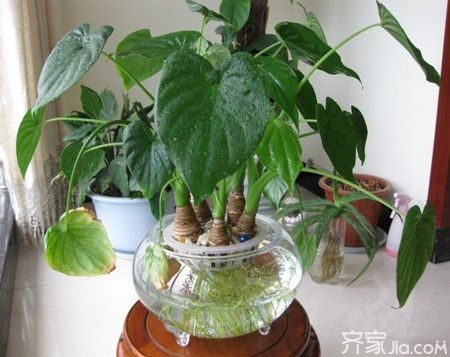
Each even-numbered pinnate compound leaf of the money tree plant is in a strong state at the base of the leaf axis, as if it is a protruding Buddha's belly. The middle and upper part of the leaf shaft are cylindrical with irregular dark brown markings, like a camouflage coat. The oval or oval leaflets on its compound leaves are thick in texture and dark green, as if they are coated with a layer of shimmering glaze in the sun. If several plants are planted together in a delicate blue and white porcelain pot, there will be a vigorous vitality, lush vitality, and high ornamental value.
8. Money trees purify the air
The money tree can absorb poisonous gases through photosynthesis and release oxygen, bringing fresh air. During the day, it can absorb carbon dioxide in the room and release oxygen at the same time, increasing the concentration of negative ions in the indoor air, and even absorbing dust that is difficult for even vacuum cleaners to absorb. More importantly, it can also absorb harmful gases such as formaldehyde and benzene to kill bacteria in the air. In this process, it effectively purifies the air and increases the green atmosphere in the space, which is refreshing.
相关知识
Money Tree
Money and your mental health
计算存款利息,本题目要求计算存款利息,计算公式为interest=money×(1+rate) year −money,interest为存款到期时的利息(税前),money是存款金额,y
High price of being a ‘money boy’
牡丹 tree peony
什么金钱树最旺财
你还经常乱花你父母的钱,你还为了钱跟你父母吵架,你难道不知道这是你父母辛辛苦苦赚来的钱吗? 的翻译是:You often spend the money your parents, you still quarrel with your parents for money, don't you know it is your parents ' hard earned money?
金钱树的室内装饰和园林景观应用.pdf
康斯妲丝·茉莉 Constance Money的全部作品(7)
2024《Money》美国最佳大学排名发布!高性价比、好就业的院校全在这了!
原文链接: Money Tree https://www.huajiangbk.com/newsview2523563.html
| 上一篇: 金钱树受寒害后的补救措施 | 下一篇: 大金钱树图片大全 |
推荐分享


- 1胡椒木盆景从上盆制作到养护,... 74485
- 2明日花キララ:明日花绮罗年度... 55822
- 3明日花キララ(明日花绮罗)经... 32526
- 4兰花叶子扭的是什么兰 22013
- 5五月天婷婷开心六月丁香:音乐... 20923
- 6李晓明工笔牡丹(魏紫)《牡丹... 20287
- 7仙人球“水蜜桃”—又美又仙,... 18159
- 8十大致癌花卉排行榜,哪些花卉... 16821
- 9超简单,3个步骤带你学会毛线... 16468
- 10老师精选05—河北彩花(出道... 15981